

Choosing the right financial professionals can feel like navigating a maze of jargon, legal requirements, and ever-changing standards. Two titles that often create confusion are accountant and auditor. While both deal with numbers, their mandates, methods, and value to your organization differ in important ways especially under the UAE’s evolving tax landscape and the growing demand for Tax Accounting Services in Dubai. This guide breaks down the key differences between accountants and auditors, explains how each supports your business growth and compliance, and offers practical tips on when to engage the right service.
What Does an Accountant Do?
An accountant is the financial backbone of day-to-day operations. Think of them as the architects who design and maintain your organization’s financial house.
- Bookkeeping and transaction recording: Capturing sales, purchases and expenses in a structured ledger system.
- Financial statement preparation: Producing profit and loss statements, balance sheets and cash-flow reports that reflect your company’s performance.
- Regulatory filings: Preparing VAT returns and corporate tax returns to meet Federal Tax Authority (FTA) deadlines.
- Budgeting and forecasting: Creating projections to guide strategic decisions and identify funding needs.
- Advisory services: Offering insights on cost control, pricing strategies and tax optimization.
In short, accountants ensure your financial data is accurate, timely and useful for internal management.
What Does an Auditor Do?
An auditor is the independent examiner who verifies the integrity of those financial statements. Their ultimate purpose is to enhance trust among stakeholders shareholders, lenders, government agencies and potential investors.
- Independent examination: Reviewing accounting records, supporting documents and internal controls to confirm that statements are free of material misstatement.
- Risk assessment: Testing areas vulnerable to fraud or error, such as revenue recognition and inventory valuation.
- Compliance confirmation: Ensuring adherence to International Financial Reporting Standards (IFRS) and UAE Commercial Companies Law, as well as sector-specific regulations.
- Opinion issuance: Delivering an audit report that states whether the financial statements present a true and fair view.
Auditors offer external assurance rather than day-to-day bookkeeping, which is why independence from management is non-negotiable.

Side-by-Side Comparison
| Feature | Accountant | Auditor |
| Primary Goal | Accurate recording and reporting | Independent verification |
| Frequency | Ongoing (daily, monthly, quarterly) | Periodic (annual or special audits) |
| Independence | Part of finance team or outsourced, but management-appointed | Must remain independent of management |
| Output | Financial statements, budgets, tax returns | Audit opinion, management letter |
| Standards | IFRS for SMEs, UAE corporate tax law, VAT Decree Law | International Standards on Auditing (ISA), IFRS compliance review |
| Regulators (UAE) | Federal Tax Authority, Ministry of Economy (for bookkeeping requirements) | Ministry of Economy (auditor licensing), free-zone authorities, banks |
Why the Distinction Matters in the UAE
- Corporate tax introduction: Beginning in June 2023, most UAE businesses became subject to a 9 percent federal corporate tax. Accountants calculate taxable income, while auditors provide assurance to the FTA and shareholders that these calculations are reliable.
- Bank financing: UAE banks often require audited financials for credit facilities above AED 5 million. Timely audits make or break loan approvals.
- Free-zone compliance: Popular zones like DMCC, JAFZA and DIFC mandate annual audited statements for license renewals.
Investor confidence: With foreign direct investment flowing into Dubai, audited statements give investors transparency and comfort.
When to Hire an Accountant, an Auditor, or Both
- Start-ups and SMEs: Engage an accountant from day one to structure your chart of accounts and ensure VAT readiness. An external audit becomes relevant once you exceed free-zone thresholds or seek funding.
- Growing businesses: As transaction volumes rise, outsourcing bookkeeping and management accounts to a firm like ADS Auditors’ accounting team frees management to focus on strategy. Annual audits support larger credit lines and investor pitches.
- Corporate groups: Multinational entities benefit from a permanent in-house accounting function and an independent audit partner who can also provide Economic Substance Regulation (ESR) assurance.
How Accountants and Auditors Collaborate
- Accountants prepare schedules and reconciliations that auditors test.
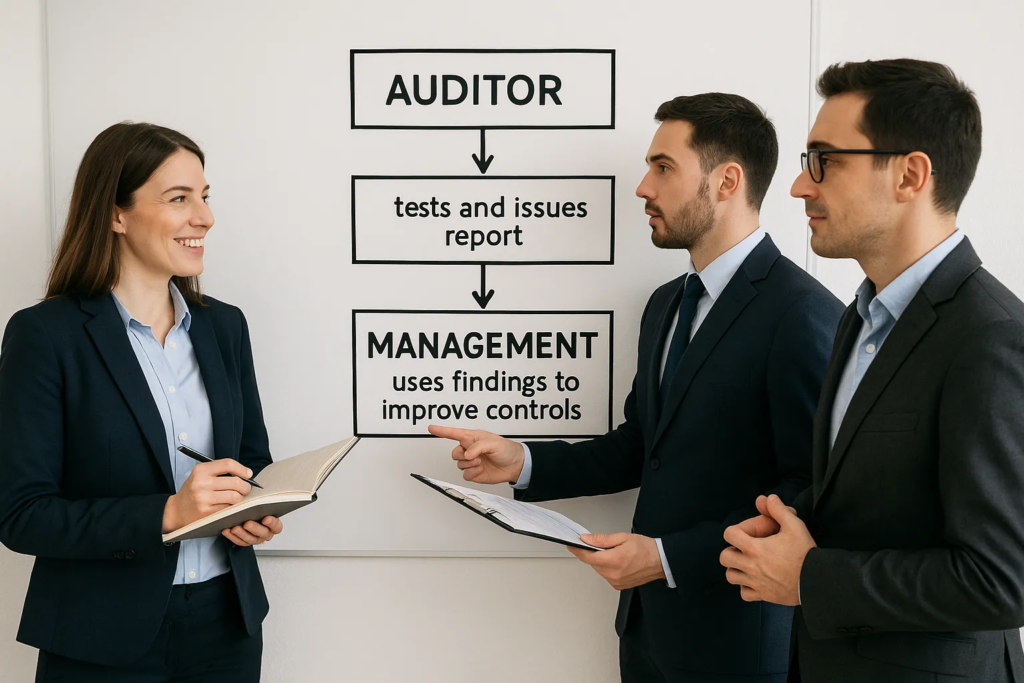
- Auditors offer recommendations in a management letter; accountants implement control improvements.
- Both functions jointly support tax consultants in crafting defensible positions for FTA inspections.
Choosing the Right Service Provider
- Credentials: Look for Chartered Accountants (CA), Certified Public Accountants (CPA), or ACCA members for accounting roles. Auditors must be registered with the UAE Ministry of Economy.
- Industry experience: Hospitality, retail and fintech each have unique compliance quirks. Select a firm with sector know-how.
- Technology stack: Cloud-based bookkeeping, data analytics and secure client portals save time and reduce errors.
- Integrated approach: Firms that offer accounting, audit, VAT and corporate tax, like ADS Auditors, deliver a seamless compliance cycle.
Practical Tips for Maximizing Value
- Automate routine entries: Use accounting software integrations for banks and POS systems to cut manual workload.
- Maintain documentation: Scan invoices and contracts; auditors request source evidence and often review records prepared during VAT Registration Services and ongoing compliance..
- Schedule pre-audit meetings: Resolve complex accounting estimates before year-end to avoid report delays.
- Leverage management letters: Treat auditor observations as a road map for internal control improvements, not criticism.
Frequently Asked Questions
Is an audit mandatory for every UAE company?
No. Mainland LLCs below certain revenue thresholds are not legally required to audit, but banks, free-zones, or investors may impose their own requirements.
Can the same firm handle accounting and auditing?
Yes, provided the audit division remains independent and follows International Ethics Standards Board for Accountants (IESBA) rules. Many businesses find one-stop firms more efficient.
How long does an external audit take?
A typical SME audit in Dubai takes 2 – 4 weeks once complete records are available. Delays often stem from missing documentation.
Will corporate tax increase my audit workload?
Slightly, because auditors must now verify tax provisions and deferred tax calculations. Good bookkeeping mitigates the extra effort.
Ready to Strengthen Your Financial Governance?
Whether you need meticulous bookkeeping, a statutory audit, Remote Accounting Services in Dubai, or end-to-end corporate tax support, ADS Auditors delivers award-winning expertise under one roof. Our licensed professionals combine global standards with deep UAE market knowledge, ensuring your numbers stand up to scrutiny and your strategy stays on track.
Contact us today for a free initial consultation and discover how integrated accounting and audit solutions can support your next phase of growth.