
Many UAE SMEs still treat accounting as a compliance function: record transactions, file VAT, close the year, then move on. In 2026, that mindset is expensive. With UAE Corporate Tax, tighter bank due diligence and faster data expectations from investors and regulators, businesses need accounting advisory that turns bookkeeping into decision-grade information.
This guide breaks down the key deliverables UAE SMEs should expect from an accounting advisory engagement, how often they should be produced, and how they directly support profitability, cash flow and compliance.
What “accounting advisory” means (and what it is not)
Accounting advisory sits between day-to-day bookkeeping and year-end audit or tax filing.
- Bookkeeping records what happened (invoices, bills, bank transactions).
- Accounting advisory explains what it means (accurate financial statements, insights, forecasts, controls and readiness for VAT and Corporate Tax).
- Audit provides independent assurance on financial statements.
- Tax compliance focuses on calculating and filing obligations, supported by clean accounting.
For SMEs, advisory is most valuable when it creates a repeatable monthly rhythm: close, reconcile, analyze, forecast and act.
Why UAE SMEs need accounting advisory now
Three practical drivers have made advisory deliverables more important than ever:
UAE Corporate Tax has raised the “quality bar” for accounts
UAE Corporate Tax is now a recurring reality for most businesses, with 0% on taxable income up to AED 375,000 and 9% above (subject to the law and relevant conditions). Tax calculations depend on the quality of your underlying accounting, your documentation and your accounting policies.
Official reference: UAE Ministry of Finance corporate tax overview is available on the Ministry of Finance site.
VAT compliance is increasingly data-driven
Even when VAT is filed on time, errors often come from weak reconciliations: misclassified supplies, reverse charge misses, incorrect place-of-supply treatment, or gaps between VAT returns and the general ledger.
For VAT fundamentals and guidance, see the UAE Federal Tax Authority resources.
Banks, investors and free zone authorities ask for structured reporting
Whether you are renewing a facility, opening a bank account, applying for a tender, or preparing for an audit, stakeholders want:
- Clear monthly financials
- Consistent revenue and margin analysis
- AR and cash visibility
- Evidence of controls and governance
Accounting advisory packages these needs into predictable deliverables.
Accounting advisory: key deliverables UAE SMEs should expect
Below are the deliverables that create the most impact for SMEs in the UAE. Not every business needs all of them on day one, but most fast-growing SMEs eventually do.
1) Monthly management accounts pack (accurate, reconciled, explained)
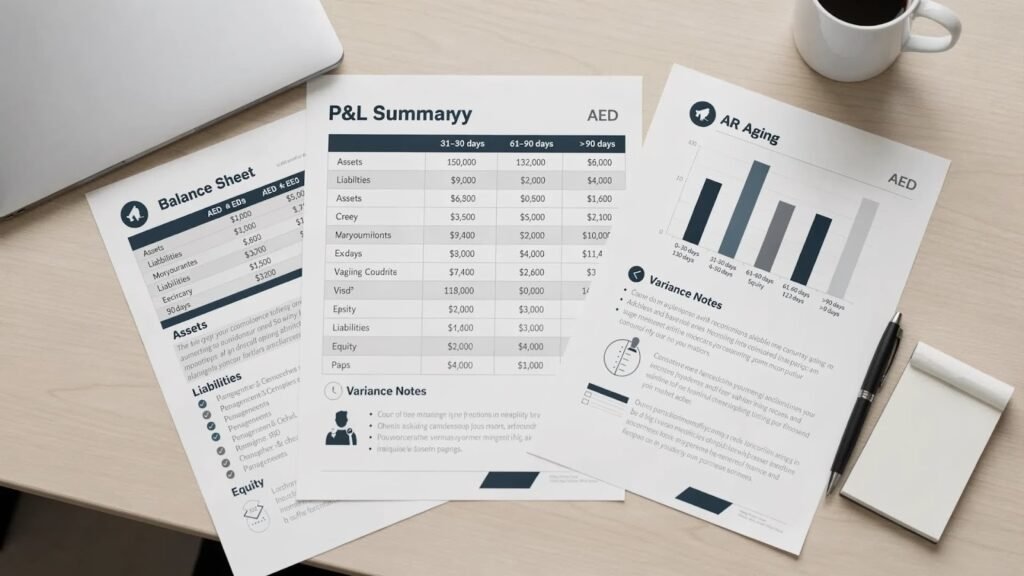
A management accounts pack is the core advisory deliverable. It should be produced after a disciplined month-end close, not as a raw export from software.
A strong pack typically includes:
- Profit and Loss (P&L) with month vs budget and month vs prior period variance commentary
- Balance Sheet with reconciled key accounts (bank, AR, AP, inventory, fixed assets, intercompany, accruals)
- Cash flow summary (actuals and near-term outlook)
- Working capital snapshot (AR aging, AP aging, inventory movement if applicable)
- Exception list (unusual entries, negative margins, unreconciled balances, credit notes trends)
What to look for: clear explanations, not just numbers. Variances should translate into actions like pricing changes, procurement renegotiations, collections focus, or cost controls.
2) Month-end close checklist and close calendar
Many SMEs “close” accounts weeks late because tasks are informal. Advisory should formalize the close so reporting becomes reliable and fast.
Typical close deliverables:
- A close checklist by day (Day 1 to Day 10, for example)
- Defined cut-off rules (sales, returns, GRNs, payroll accruals)
- A list of required reconciliations (bank, VAT control accounts, intercompany, key accruals)
- A documented review and approval workflow
This is also where tools like a compliance calendar become valuable, helping teams avoid deadline-driven surprises. (ADS Auditors offers a compliance calendar tool; if you want to operationalize deadlines across VAT, Corporate Tax, ESR and audit readiness, it is worth aligning your close rhythm with that calendar.)
Related reading: ADS Auditors’ resource on building a scalable finance function, see Accountancy Services Checklist for Growing SMEs.
3) Cash flow forecasting (13-week forecast plus scenarios)
Profit does not pay salaries. Cash does.
A practical accounting advisory deliverable is a 13-week cash flow forecast that is updated weekly or bi-weekly. It should include:
- Expected collections by customer (based on invoices and realistic payment behavior)
- Payroll and fixed outflows
- VAT payment/refund timing assumptions
- Loan repayments and lease commitments
- Scenario toggles (best case, base case, conservative)
For SMEs in project-based industries (construction, agencies, IT services), the forecast should link to project milestones and billing schedules.
4) VAT-ready reconciliations (VAT control accounts and return mapping)
VAT compliance improves dramatically when advisory builds a reconciliation framework.
Key deliverables include:
- VAT return mapping to the chart of accounts
- VAT control account reconciliations (input VAT, output VAT)
- Exception testing (zero-rated, exempt, reverse charge, imports)
- A documented VAT position summary for the period
This is not meant to duplicate VAT filing support. It is meant to ensure VAT is supported by clean books, so filings become faster and less risky.
If your team needs the operational how-to, ADS Auditors also has a step-by-step guide: How to File VAT Return in the UAE.
5) Corporate tax readiness pack (tax-sensitive accounting, not last-minute fixes)
A common SME mistake is to treat Corporate Tax as a year-end “tax calculation exercise.” In practice, corporate tax readiness is built monthly.
Advisory deliverables that support Corporate Tax include:
- A taxable income bridge concept: accounting profit to estimated taxable profit (high level)
- Identification of non-deductible or restricted expense categories that need tracking
- Fixed asset and depreciation schedules aligned to policy
- Documentation pack readiness (contracts, invoices, related party support where relevant)
For deadlines planning and internal timing, see: When Are Corporate Tax Returns Due? Key Deadlines Every Business Should Know.
6) KPI dashboard tailored to your business model
Good advisory turns your finances into a small set of KPIs that management can act on.
Examples by model:
- Trading: gross margin by category, inventory turns, shrinkage, landed cost variance
- Services: utilization, realization rate, project margin, WIP and unbilled revenue
- Ecommerce: contribution margin, CAC payback (if applicable), returns rate, fulfillment costs
The deliverable should define:
- KPI definitions (so teams do not argue about formulas)
- Data source (GL, sales system, payroll, CRM)
- Target thresholds and alerts
7) Budget, rolling forecast and variance narratives
Budgets fail when they are created once and ignored. SMEs benefit from a simple cadence:
- Annual budget (high-level)
- Rolling forecast (monthly refresh for next 6 to 12 months)
- Variance narratives (what changed, why and what you will do)
A helpful advisory output is a one-page “forecast memo” summarizing assumptions such as headcount plans, pricing changes, churn or pipeline conversion and supplier cost movement.
8) Accounting policies and IFRS alignment (practical, SME-friendly)
Many UAE stakeholders (banks, investors, some free zones) expect financial statements aligned with IFRS or at least built on consistent accounting policies.
Common policy deliverables include:
- Revenue recognition approach (especially for projects, subscriptions, deliverables)
- Expense capitalization vs expensing rules
- Fixed asset capitalization threshold and depreciation policy
- Provisioning policy (bad debts, obsolete inventory)
Reference: the IFRS Foundation provides standards and guidance (implementation should be tailored to your size and stakeholder needs).
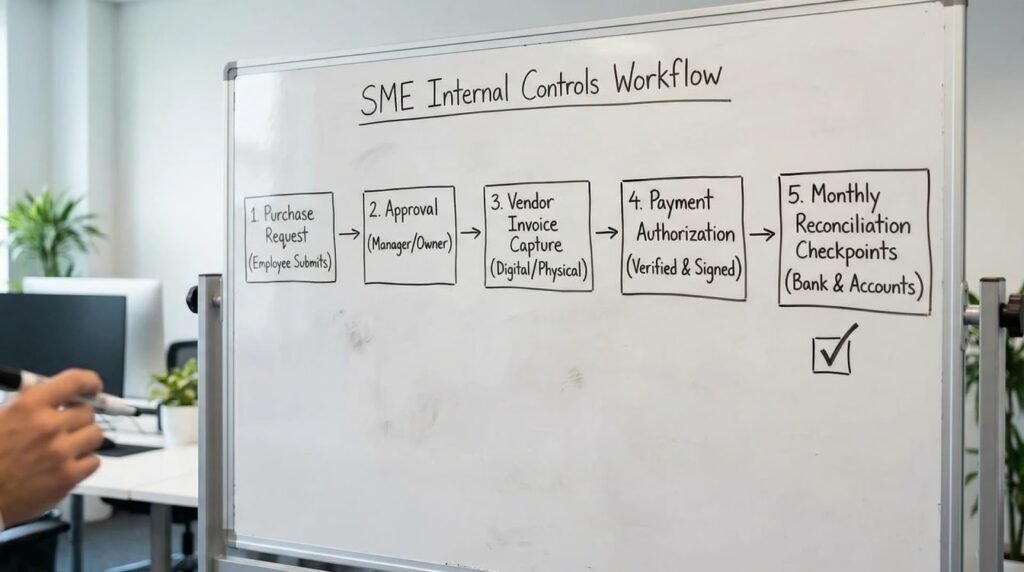
9) Internal controls “minimum viable controls” pack
Controls are not only for big corporations. For SMEs, a small set of controls can prevent most losses and most reporting errors.
Advisory deliverables often include:
- Segregation of duties map (who creates, approves, pays)
- Approval matrix (spend limits, vendor onboarding, credit notes)
- Monthly control checks (bank rec review, AR aging review, VAT reconciliation sign-off)
- Document retention rules and audit trail expectations
10) Audit and assurance readiness file
Even when an audit is not legally mandated, being audit-ready reduces finance costs and improves credibility.
Audit readiness deliverables include:
- Lead schedules (AR, AP, fixed assets, accruals)
- Support folders (contracts, invoices, bank confirmations preparation)
- A list of significant judgments (revenue cut-off, provisions)
For SMEs deciding what level of assurance they need, see: Audit and Assurance: What They Mean for UAE SMEs.
Deliverables by frequency (what “good” typically looks like)
The table below shows a practical cadence for most UAE SMEs.
| Deliverable | Monthly | Quarterly | Annual | Primary value |
| Month-end close checklist + reconciliations | Yes | Review | Refresh | Faster, cleaner reporting and fewer surprises |
| Management accounts pack (P&L, BS, variance) | Yes | Enhanced analysis | Consolidated view | Better decisions, stakeholder confidence |
| 13-week cash flow forecast | Update | Scenario refresh | Strategy integration | Prevent cash crunches, plan funding |
| VAT control reconciliations | Yes (if VAT-registered) | Deep-dive | Year-end tie-out | Fewer VAT errors and smoother filings |
| Corporate tax readiness summary | Light touch | Stronger review | Full computation support | Avoid last-minute rework and reduce tax risk |
| KPI dashboard | Yes | Recalibrate targets | Reset KPI framework | Operational focus and accountability |
| Budget and rolling forecast | Update | Re-forecast | Build annual budget | Resource planning and growth control |
| Accounting policies and controls | Monitor adherence | Improve | Formalize | Consistency, auditability, fewer disputes |
What UAE SMEs should ask their accounting advisory provider
Before engaging an advisor, align on outcomes. Useful questions include:
- What does your month-end close process look like and what reconciliations will be delivered?
- Will we receive a management accounts pack with commentary, or only statements?
- How will you connect accounting outputs to VAT and Corporate Tax readiness without duplicating work?
- What is the expected timeline to get reporting “clean” (first close vs third close)?
- How do you handle documentation and secure data sharing?
A good provider should be comfortable showing sample pack structures (with client data removed) and defining who owns what.
Quick self-check: do you need accounting advisory (or just bookkeeping)?
If you answer “yes” to two or more, advisory usually pays for itself:
- Your monthly financials are delayed by more than 15 to 20 days
- You have recurring surprises in VAT payable or VAT refunds
- You cannot explain margin changes by product, customer, or project
- Cash is tight even when sales are growing
- Your balance sheet has old unreconciled balances (suspense, advances, intercompany)
- Banks or investors ask for reports you cannot produce quickly
- Corporate tax planning feels like a year-end scramble
Build an advisory-ready finance function with ADS Auditors
ADS Auditors is one of the trusted accounting firms in Dubai, supporting UAE SMEs with accounting, VAT, Corporate Tax, audit readiness and business advisory services. The firm maintains a practical, deliverables-focused approach providing reports and insights that management can actively use for decision-making and compliance.
To discuss the right monthly package, forecasting model and compliance rhythm tailored to your business, explore the firm’s resources or contact ADS Auditors via adsauditors.com.
Frequently Asked Questions
What is included in accounting advisory for a UAE SME?
Accounting advisory typically includes a structured month-end close, reconciliations, management accounts with commentary, cash flow forecasting, KPI reporting and compliance readiness for VAT and Corporate Tax.
How is accounting advisory different from outsourcing accounting?
Outsourcing accounting often focuses on processing and compliance. Advisory adds analysis, forecasting, controls and decision support, usually with management reporting that leaders can act on.
How often should management accounts be prepared?
Most SMEs benefit from monthly management accounts. Fast-growing businesses, ecommerce and project-based firms often need monthly accounts plus a weekly cash forecast.
Do accounting advisory deliverables help with UAE Corporate Tax?
Yes. Clean reconciliations, consistent accounting policies and tax-sensitive tracking of expenses and documentation make Corporate Tax filing more accurate and reduce rework.
Can an SME get advisory without hiring a full-time CFO?
Yes. Many SMEs use a part-time or outsourced advisory model that delivers CFO-level outputs (like forecasts and dashboards) without the fixed cost of a senior hire.