
When a business ceases operations it is generally required to deregister for corporate tax with the relevant tax authority. If the deregistration is not completed at the right time, the business may continue to have filing obligations, receive compliance notifications, and potentially face administrative penalties.
ADS Auditors provides professional support for corporate tax cancellation, helping businesses complete deregistration accurately, with the right documentation, and within the timelines set by the applicable authority. If you need clear, end-to-end tax deregistration services, our team can guide you through the process from eligibility review to final confirmation.
What Is Corporate Tax Deregistration?
Corporate tax deregistration is the formal process of cancelling a business’s corporate tax registration with the tax authority once the business is no longer required to remain registered. In simple terms, it removes the entity from the corporate tax register so that the authority no longer expects future corporate tax returns from that entity, subject to approval and completion of all final compliance requirements. The deregistration application must generally be submitted within 3 months from the date of business closure or trade licence cancellation.
A company tax deregistration request can be:
- Mandatory, where the entity is being legally closed, meaning the business should not remain registered.
It is important to separate corporate tax deregistration from other closure tasks. Business tax deregistration is not the same as VAT deregistration, and it is not the same as cancelling a trade license or other operating permits. These are different processes, often handled through different systems, with different timelines and document requirements.
A business should typically deregister for corporate tax when it no longer meets the conditions for remaining registered. Common situations include:
- The business has ceased all taxable business activities (for example, operations have stopped and there is no intention to restart).
- The company is being liquidated or dissolved, and the entity will no longer exist.
- Restructuring or group changes, where a registered entity is closing and activities are moving to another entity.
Because deregistration rules can depend on facts and timing, it is good practice to document the reason for corporate tax cancellation clearly before starting the application. This helps reduce back-and-forth queries and avoids delays during the authority’s review.
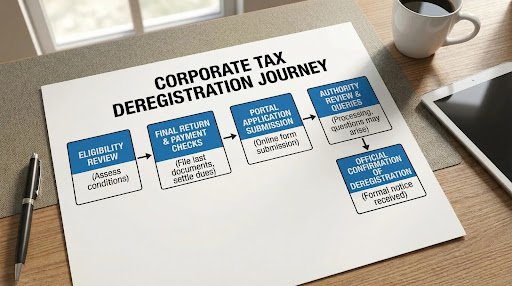
While the exact workflow can vary, the business tax deregistration process generally follows a similar sequence.
1) Confirm compliance before applying
Before submitting a deregistration application, businesses generally need to confirm that all outstanding corporate tax obligations have been met. In practice, this often includes:
- Ensuring required corporate tax returns are prepared and filed
- Settling any corporate tax amounts due (including any assessments raised by the authority)
- Addressing any open compliance items that could block approval
Tax authorities typically will not approve corporate tax cancellation if filings or payments are overdue. This is one of the main reasons deregistration requests get delayed.
If you need support to close out prior obligations, ADS Auditors can help with your Corporate Tax Filing and related reconciliations.
2) Prepare the deregistration submission
Once eligibility is clear, the next step is to submit the deregistration application through the relevant tax authority portal, along with supporting information. Depending on the business’s situation, the authority may request additional clarifications.
If you are still in the early stage of compliance and need to confirm your registration position before exiting, reviewing your original Corporate Tax Registration basis can be helpful.
3) Provide supporting documents
Supporting documentation is usually required to show why the business qualifies to deregister for corporate tax and to confirm that final obligations have been met. The authority may request specific evidence based on entity type, closure method, and transaction history.
4) Tax authority review and follow-ups
After submission, the authority reviews the request and may raise questions or request further documents. Responding accurately and promptly matters, since inconsistent information can trigger extended review.
5) Receive official confirmation
If approved, the business receives cancellation. This confirmation is important to retain in the company’s compliance records.
For businesses that need decision support before filing, ADS Auditors can assist through Corporate Tax Consultation to clarify the right approach based on your operational status and documentation.
Document requirements vary depending on the business’s circumstances and the authority’s guidance. That said, businesses commonly prepare items such as:
- Evidence of business cessation or closure steps (for example, trade license cancellation documents or equivalent evidence)
- Final corporate tax return details (as applicable) and payment confirmation
- Supporting documents explaining the reason for company tax deregistration (for example, dissolution documents, restructuring approvals, or internal closure resolutions)
- Any additional information requested during the review, such as clarifications on last taxable period, outstanding receivables, or final transactions
A practical tip is to keep your deregistration file organized as a single “closure pack” with clear labels. This can make it easier to respond if the authority raises queries after submission.
Many delays happen because businesses treat deregistration as a simple form submission. In reality, the authority’s approval is closely linked to filing, payment, and evidence.
Common mistakes include:
- Applying for deregistration before filing required returns or paying outstanding liabilities
- Missing the deadline to submit the deregistration application after the business closes or stops taxable activities
- Submitting incomplete or inconsistent documentation that triggers follow-up questions
- Assuming that closing a trade license automatically completes business tax deregistration
- Not seeking professional support, leading to avoidable delays, incorrect submissions, or continued compliance obligations
If VAT registration is also involved, review VAT Deregistration separately, and maintain a coordinated plan across your Compliances to avoid gaps during closure.
Corporate tax deregistration often happens during busy periods such as closure, restructuring, or financial clean-up. ADS Auditors supports clients with practical, compliance-focused tax deregistration services so the process is handled clearly and on time.
Our support typically includes:
- Reviewing corporate tax filing history to confirm what is outstanding before you apply to deregister for corporate tax
- Advising on the information and evidence commonly needed to support the deregistration request
- Preparing and organizing documentation in a structured submission pack
- Submitting the deregistration application and supporting information through the appropriate portal (based on client authorization)
- Tracking progress, responding to queries, and following up with the authority until a final outcome is issued
When deregistration is part of a wider closure plan, we can also help align it with your reporting and reconciliation work through Tax Accounting and broader compliance coordination via Compliances. For questions on interpretation, timing, or interaction with ongoing obligations, our team can support through Corporate Tax Consultation.
Corporate tax deregistration is often one part of a larger compliance picture. Managing related processes together helps reduce errors and prevents “unfinished” obligations.
Here is how corporate tax cancellation typically connects to other requirements:
|
Process |
What it covers |
Key point to remember |
|
Corporate tax deregistration |
Removing the entity from the corporate tax register |
Approval usually depends on final filings and payments being up to date |
|
VAT deregistration |
Ending VAT registration and VAT return obligations |
Separate application and separate evidence may be needed |
|
Final returns and record retention |
Completing final filings and keeping supporting records |
Filing obligations can continue until the authority confirms cancellation |
If VAT also applies, handle it independently and plan for timelines using VAT Filing and VAT Deregistration. For corporate tax, ensure outstanding obligations are closed through Corporate Tax Filing even while the deregistration request is in progress.
If your business is closing, restructuring, or no longer required to be registered, professional support can help you complete corporate tax cancellation accurately and on time, and avoid unnecessary ongoing compliance obligations.
Contact ADS Auditors to discuss your situation and get reliable, professional tax deregistration services
What does it mean to deregister for corporate tax?
It means submitting a formal request to cancel a business’s corporate tax registration with the tax authority once the business is no longer required (or eligible) to remain registered.
When is a business required to apply for corporate tax cancellation?
A business typically needs to apply when it is being dissolved, or otherwise no longer meets the conditions for continued registration, based on the authority’s rules.
Is corporate tax deregistration the same as VAT deregistration?
No. Corporate tax deregistration and VAT deregistration are separate processes with different requirements and timelines.
What happens if a business does not deregister for corporate tax after closing?
The tax authority may continue to treat the entity as registered, which can result in ongoing filing expectations, compliance reminders, and potential administrative penalties.
How long does the corporate tax deregistration process take?
Timelines vary based on the business’s facts, the completeness of documentation, and whether the tax authority raises queries during review.
Can ADS Auditors handle the deregistration process on behalf of my business?
Yes. ADS Auditors can provide tax deregistration services, including eligibility checks, documentation support, submission assistance, and follow-up until an outcome is issued.