
If you are a new business in the UAE, your VAT certificate can quickly become more than a “tax document”. It is often a proof point for banks, suppliers, and investors that your finance function is set up correctly. In practice, founders usually search for How to Get a VAT Certificate when they hit one of these triggers:
- A customer asks for your TRN before paying an invoice.
- A marketplace or corporate client requires VAT-compliant invoicing.
- A bank onboarding or due diligence checklist asks for VAT registration details.
This guide explains the process in simple steps, plus the strategic choices that help you avoid delays and rework.
What a “VAT certificate” means in the UAE?
In the UAE, once the Federal Tax Authority (FTA) approves your VAT registration, you receive a Tax Registration Number (TRN) and you can download your VAT Registration Certificate from the FTA portal (often referred to as the VAT certificate).
You will use it to:
- Show your TRN on tax invoices and (in many cases) contracts
- Support zero-rated and export documentation workflows
- Build credibility during finance, audit, and investor reviews
For official guidance, refer to the Federal Tax Authority resources and VAT public guidance.
Do I need a VAT certificate to start trading? You can legally start trading without VAT registration if you are below the threshold, but once you must register, delays can create compliance risk and customer friction.
Step 1: Confirm whether you should register (mandatory vs voluntary)
The most common reason VAT applications go wrong is registering too late, or registering when you are not ready to support the numbers.
UAE VAT registration generally depends on your taxable supplies (sales that are standard-rated at 5% or zero-rated) measured over time.
Here is a practical decision table used by many VAT consultants in UAE during onboarding:
| Scenario | Typical turnover test | What it means for you |
| Mandatory registration | Above AED 375,000 | You should register and obtain a TRN, then charge VAT where applicable |
| Voluntary registration | Above AED 187,500 (but below AED 375,000) | You may register to reclaim input VAT and look “enterprise-ready” (if your records are clean) |
| Below voluntary threshold | Below AED 187,500 | Usually wait, but build VAT-ready bookkeeping now |
These thresholds are widely referenced in UAE VAT rules and FTA guidance.
Can I register voluntarily just to look bigger for investors? Sometimes, but investors usually care more about clean books and compliant invoicing than having a TRN early. Voluntary registration makes sense when you have real input VAT to reclaim and strong documentation.
Step 2: Build a “VAT-ready” file before you apply
Think like an FTA reviewer. Your application is stronger when your story matches your documents: licensing activity, invoices, contracts, bank flows, and (where relevant) customs activity.
A simple preparation sprint (often 3 to 7 days for an organized startup) includes:
- Confirm your legal entity details match your trade license (name, activity, address)
- Reconcile sales to bank statements (even if you are pre-revenue, explain deposits clearly)
- Separate taxable vs exempt income lines (if any)
- Set up basic accounting categories that will later map into VAT returns
A real-world investor lesson (what changes after your first term sheet)
A common pattern we see in the market is a seed-funded startup that closes funding, then immediately needs stronger finance controls for bank onboarding and enterprise clients. In those cases, VAT registration becomes part of the broader “finance stack” upgrade, along with monthly closes, clean revenue recognition, and documented tax positions.
That is why many founders engage tax assistant accountants or specialist advisors early, not because the form is hard, but because the evidence behind the form must be consistent.
Step 3: Prepare the documents (the checklist that prevents delays)
Exact requirements can vary by entity type and activity, but new businesses commonly prepare:
- Trade license
- Passport and Emirates ID (where applicable) for owners/authorized signatories
- Memorandum/Articles of Association (or equivalent formation documents)
- Proof of business address (as applicable)
- Bank account details (or explanation if the account is still in process)
- Sales evidence supporting the threshold (invoices, contracts, bank statements)
- Purchase invoices (especially if you are registering voluntarily to reclaim input VAT)
- Import/export documentation (if relevant)
What if my business bank account is not open yet? Many new businesses face this timing issue. You can still prepare most of the VAT file, but missing banking details or unclear source-of-funds narratives can slow reviews. Align your VAT plan with your bank onboarding plan.
Step 4: Submit the VAT registration application on the FTA portal
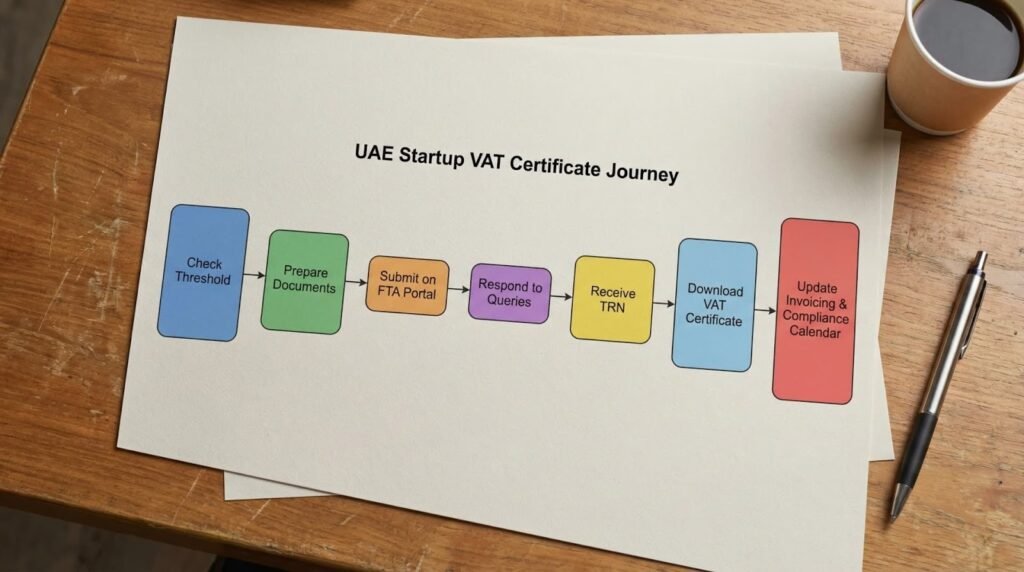
VAT registration is completed online through the FTA’s digital platform (often referred to as e-Services/EmaraTax depending on the service view). The core workflow is:
- Sign up for a new FTA account.
- Start a VAT registration application.
- Enter entity details, business activity, ownership, and contact information.
- Declare turnover and attach supporting documents.
- Review carefully, then submit.
The fields that create the most problems
Based on practical filing experience across vat services in Dubai, these are frequent “slowdown” areas:
- Mismatch between trade license activity and your described business model
- Turnover numbers that do not tie to uploaded invoices or bank statements
- Wrong VAT treatment assumptions (standard-rated vs zero-rated vs exempt)
- Weak explanation for voluntary registration (no clear input VAT recovery case)
If you want a deeper UAE walkthrough, ADS Auditors also shares a related guide on VAT registration for a new company.
Step 5: Respond to FTA queries quickly (this is where timelines are won or lost)
After submission, the FTA may:
- Approve directly
- Request clarification or additional documents
Many approvals happen in business days when the file is consistent, but timelines vary depending on the quality of documentation and query volume.
A helpful internal rule used by best VAT consultants in Dubai is: treat every query as a mini-audit. Answer with clear notes, matching attachments, and reconciliations (not just screenshots).
How long does it take to get the VAT certificate? If your application is complete, approvals can be relatively quick, but there is no universal timeline. Plan for queries and build buffer time, especially if a client contract depends on your TRN.
Step 6: Download your VAT certificate and operationalize it
Once approved, you will receive your TRN and can download the VAT certificate from the portal.
Now the important part is implementation:
- Update your invoice template to include TRN and VAT breakdown
- Train your sales team on when to charge VAT (and when not to)
- Adjust pricing and contracts (clarify whether prices are VAT inclusive or exclusive)
- Set a filing rhythm and document storage process
If you are new to filing, keep this guide bookmarked: How to file a VAT return in the UAE.
Strategic comparison: DIY registration vs using VAT consultants
Most founders can submit a VAT application themselves. The question is the “hidden cost” of delays, rejections, or future corrections.
| Area | DIY approach | With vat consultancy services (example: ADS Auditors) |
| Speed to submit | Fast if documents are ready | Fast, plus structured document pack and review |
| Risk of mismatch | Higher (business model, turnover evidence, VAT treatment) | Lower, due to pre-checks and reconciliations |
| Query handling | Can be stressful and time-consuming | Managed with clearer explanations and supporting schedules |
| Post-certificate setup | Often missed (invoicing, VAT coding, calendar) | Usually built into an end-to-end compliance plan |
ADS Auditors (ADS tax consultancy) typically supports businesses not only with registration, but also with ongoing VAT services in Dubai like invoicing readiness, return filing support, and process controls.
2026 trends to keep in mind (so you do not redo the work later)
VAT compliance in the UAE is increasingly data-driven. New businesses should plan for these realities:
- More data matching between invoices, customs declarations, and VAT returns, which means cleaner bookkeeping matters from day one.
- Faster audit readiness expectations, especially when you grow from SME to mid-market.
- Integration with finance systems, even simple accounting software, reduces errors and improves response time to queries.
A practical takeaway: do not treat the VAT certificate as the finish line. Treat it as the start of a repeatable compliance system.
Do I need to show the VAT certificate to customers? Many customers only need your TRN on the invoice, but some procurement teams ask for the certificate during vendor onboarding.
When to get help?
Consider speaking with vat consultants in Dubai if:
- You are close to the mandatory threshold and timing is tight
- You have mixed supplies (standard-rated, zero-rated, exempt)
- You import goods and are unsure about customs VAT and reverse charge rules
- You want voluntary registration mainly to reclaim VAT and need to justify it properly
ADS Auditors can also align VAT registration with your broader accounting, compliance calendar, and growth plans, so you stay ready for bank reviews and investor due diligence.