

VAT compliance is getting more operational in the UAE. The Federal Tax Authority (FTA) increasingly matches VAT returns with financials, customs data, and e-invoicing style records from accounting systems. That is why many SMEs and fast growing groups now treat VAT Filing Services in UAE as a monthly finance process, not a once-a-quarter admin task.
This guide breaks down what businesses usually want to know before outsourcing or upgrading their VAT process: cost drivers, realistic timelines, and practical tips that reduce errors and protect cash flow. You will also see investor-style lessons learned, the kind that show up during due diligence, funding rounds, and M&A.
What VAT filing services usually include (beyond submitting VAT201)
A basic VAT return submission is only the last step. In practice, strong VAT Filing Services look like a mini “VAT close” that connects your sales, purchases, customs imports, and bank movements.
Most businesses need help with:
- VAT data preparation: cleaning invoice data, confirming TRNs, and separating standard-rated, zero-rated, exempt, and out-of-scope supplies.
- Reconciliations: tying VAT return boxes to your general ledger (GL), trial balance, and bank.
- FTA readiness: keeping records in the format and detail the FTA expects.
- Risk flags: spotting repeated errors (reverse charge, imports, entertainment blocks, mixed-use costs).
- Refund support: where eligible, preparing clean documentation for claims (often called vat refund services in uae).
If you want the click-by-click filing process, see ADS Auditors step-by-step guide: How to File VAT Return in the UAE.
Key UAE VAT filing facts
The basics are simple, but they drive your internal calendar:
| VAT compliance item | What it means in practice | Why it matters |
| Standard VAT rate | 5% | Pricing, invoicing, and margin accuracy |
| Mandatory VAT registration threshold | AED 375,000 taxable turnover | Many SMEs cross this earlier than expected |
| Voluntary registration threshold | AED 187,500 taxable turnover | Can improve input VAT recovery for growing firms |
| VAT return deadline | Typically within 28 days after the tax period ends | Late submission can trigger penalties and cash flow issues |
Costs: what drives VAT filing fees in the UAE (and how to estimate your own)
There is no single “market price” that fits every company, because VAT filing effort depends more on data quality than company size.
The 6 biggest cost drivers
| Cost driver | What increases cost | A practical way to reduce cost |
| Transaction volume | Many invoices, POS receipts, high-frequency orders | Summarize correctly (without losing audit trail) and automate sales reports |
| Data quality | Missing TRNs, inconsistent invoice fields, manual spreadsheets | Use a consistent invoice template and basic validations |
| Imports and customs | Multiple shipments, import VAT, complicated incoterms | Reconcile customs entries monthly, not at quarter end |
| VAT complexity | Zero-rated exports, exempt supplies, partial recovery | Set VAT rules per product and per supplier in your accounting system |
| Multi-entity or multi-branch | Several TRNs or reporting units | Standardize charts of accounts and VAT mapping across entities |
| Refund behavior | Frequent refund claims or large input VAT | Keep evidence packs ready (contracts, invoices, proof of export, shipping docs) |
DIY vs in-house vs outsourced VAT filing (a simple comparison)
Most UAE businesses end up in one of these models:
| Model | Best for | Hidden risk to watch |
| DIY filing (owner or admin) | Very small volume, simple sales and purchases | Errors repeat each period, then become expensive to fix later |
| In-house finance team | Stable companies with a trained accountant | Key-person risk, knowledge leaves if staff changes |
| Outsourced filing to specialists | Growth-stage SMEs, groups with imports, or mixed VAT supplies | Make sure the provider reconciles to GL, not only “fills boxes” |
Tip: ask any provider (including tax consultants in uae) whether they do a VAT control account reconciliation each period. This is often the difference between a clean process and a risky one.
Timelines: a realistic VAT filing calendar (what strong teams follow)
The UAE deadline comes quickly, so the winning strategy is to compress your “VAT close” into the first week after the period ends.
Here is a realistic timeline many finance teams adopt:
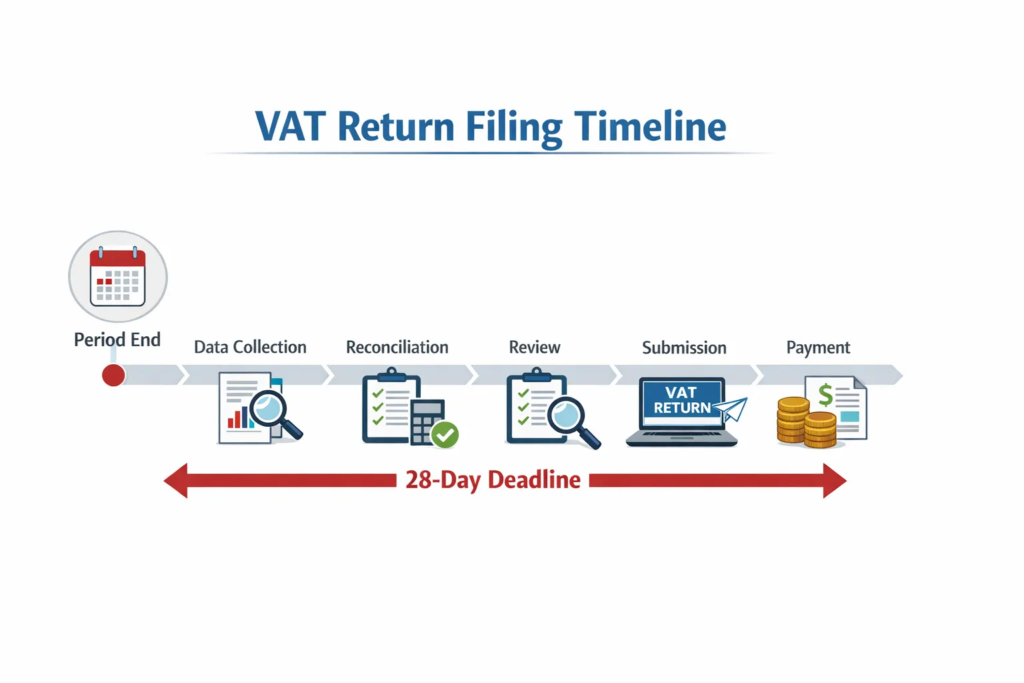
| Time window (example) | What gets done | Outcome |
| Day 1 to 3 after period end | Collect sales, purchase, and customs reports. Check missing invoices. | No late scrambling for documents |
| Day 4 to 7 | Reconcile VAT to GL, review exceptions (reverse charge, zero-rating). | Boxes align with books |
| Day 8 to 12 | Management review, fix mapping, prepare working papers. | Audit trail is ready |
| Day 13 to 20 | Submit VAT return and plan payment. | On-time submission |
| Day 21 to 28 | Buffer for corrections and bank payment processing. | Avoid last-minute risks |
This is also why businesses increasingly choose established audit firms in Dubai for VAT work, because audits and VAT rely on the same discipline: reconciliations, evidence, and repeatable controls.
Tips that reduce VAT errors and improve cash flow (strategic, not generic)
Tip 1: Treat VAT like a monthly close, even if you file quarterly
Quarterly filers often wait till the end, which is how errors compound. A monthly VAT review keeps your books clean and protects working capital.
A practical rule used by many controllers: if you cannot explain your VAT position in 10 minutes using reconciliations, your VAT return is not ready.
Tip 2: Build an “investor-grade” VAT evidence pack
Investors and acquirers rarely ask for VAT returns only. They ask for:
- VAT returns plus payment proof
- VAT reconciliation to audited financials
- Aging of VAT payable or receivable
- Evidence for zero-rated supplies (especially exports)
Lesson learned from a due diligence scenario: a regional investor paused a minority investment when VAT returns did not reconcile to revenue in management accounts. The business was still healthy, but the delay reduced negotiating power and extended the deal timeline.
Tip 3: Plan VAT refunds like a cash flow project
Businesses that frequently have input VAT (for example, exporters, heavy importers, or firms investing in equipment) should manage VAT like working capital.
Common reasons refund claims slow down are incomplete supporting documents, weak export evidence, and mismatches between invoices and bank payments.
If refunds are part of your model, use a structured approach and consider specialist support. ADS Auditors also shares a dedicated guide here: How to Get VAT Refund in Dubai (Businesses).
Tip 4: Watch the “high scrutiny” zones (where the FTA focuses)
In 2025 and 2026, many businesses report more internal effort in these areas:
- Zero-rated vs exempt classification: mistakes change your recoverable input VAT.
- Imports and reverse charge: small errors repeat and become large over time.
- Credit notes and adjustments: timing issues can distort VAT payable.
To reduce risk, keep your documentation consistent. This ADS Auditors checklist helps: Mandatory Documents Required for VAT Filing in the UAE.
Tip 5: Use a compliance calendar (and assign owners)
Missed deadlines are rarely a “tax problem.” They are usually an ownership problem.
If you manage multiple obligations (VAT, corporate tax, ESR, AML), consider using a compliance calendar and assign a clear owner per task. ADS Auditors provides a compliance calendar tool as part of its broader compliance support, which is useful for groups juggling several timelines.
A simple decision test: when should you outsource VAT filing?
Outsourcing becomes strategic when VAT is consuming leadership time or creating deal risk.
Consider external VAT Filing Services in UAE if:
- Your VAT payable swings without a clear operational reason.
- You are planning a funding round, bank facility, or business sale.
- You have imports, exports, or mixed taxable and exempt supplies.
- You want to reduce rework and fix issues before they become penalties.
For a broader view of why VAT filing matters beyond compliance, see: What Is VAT Filing and Why It’s Important for Your Business.
Frequently Asked Questions
How long does VAT filing take in the UAE?
Most businesses need several days to two weeks after period end to prepare clean data, reconcile to the GL, and finalize the VAT return. The submission deadline is typically within 28 days after the tax period ends.
What impacts the cost of VAT filing services the most?
Transaction volume matters, but data quality matters more. Missing invoices, weak VAT mapping, and unreconciled accounts usually increase time and cost.
Can VAT filing services also help with VAT refunds?
Yes. Many providers support refund preparation by organizing evidence, validating input VAT, and reducing errors that can slow down processing. If refunds are frequent, you may want specialist vat refund services in the UAE.
Is it safe to outsource VAT filing to tax consultants in the UAE?
It can be very effective if the provider reconciles VAT to your accounting records, maintains working papers, and supports you during FTA queries. Ask what checks they run before submitting.
Why do businesses involve audit firms in Dubai for VAT compliance?
Audit-minded teams tend to build stronger evidence packs and reconciliations, which reduces risks during FTA reviews and during investor or bank due diligence.
Speak with ADS Auditors for VAT filing support
If you want VAT returns that reconcile to your books, support refund claims, and stand up to investor or lender scrutiny, ADS Auditors can help you design a repeatable VAT close process and handle end-to-end submissions.
Explore the firm’s approach at ADS Auditors or contact the team to discuss the right level of VAT support for your business.