Opening a bank account looks simple on paper, but in practice banks apply rigorous compliance checks, especially in the UAE where AML and sanctions controls are strong. If you plan to open account at bank level in Dubai, understanding the exact requirements for opening a bank account, the sequencing of steps, and how to evidence your business model will save weeks of back and forth. This guide distills what ADS Auditors sees on the ground, plus 2025 trends, to help you move from application to activation with fewer delays.
The compliance core banks must satisfy
Banks in the UAE must prove they know who you are and where your money comes from. That translates into three non‑negotiables:
- Customer due diligence and ongoing monitoring, see Central Bank guidance on AML and CFT. For reference, start with the Central Bank of the UAE AML page: centralbank.ae/en/aml-cft
- Identification of ultimate beneficial owners for entities, aligned with Ministry of Economy UBO requirements, see moec.gov.ae
- Sanctions and politically exposed person screening, source of funds and source of wealth checks
These obligations drive most document requests and interviews during Bank Account Opening in Dubai.
Essential documents, personal and business
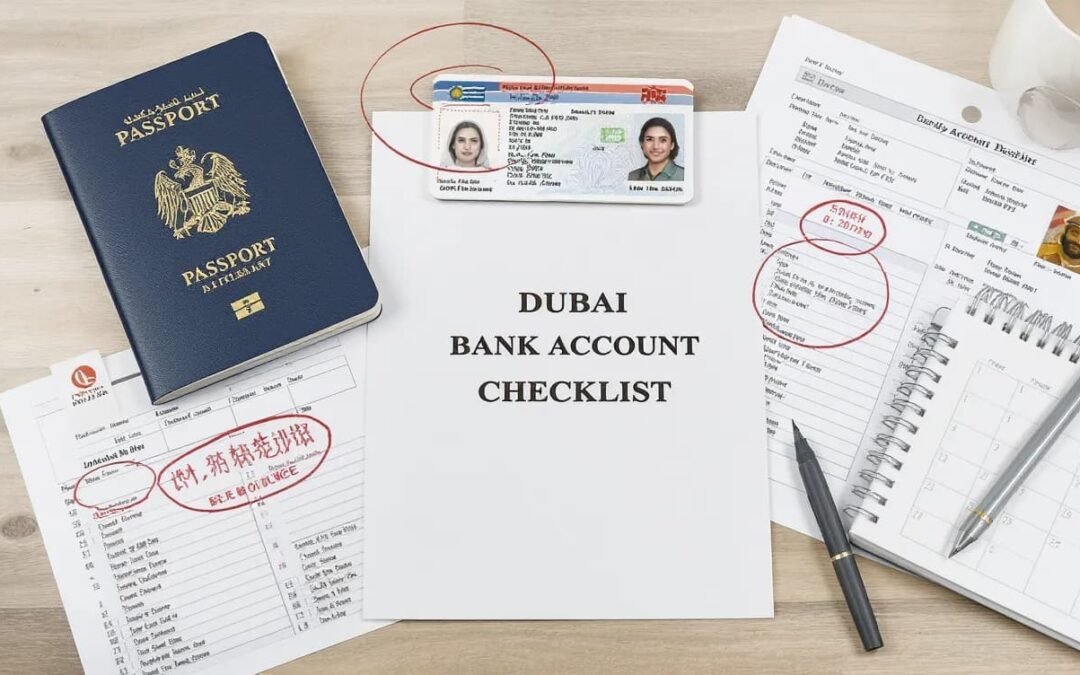
Requirements vary by bank and risk profile, but the following checklist covers what is commonly requested.
| Document | Personal account | Business account |
| Passport and UAE residence visa | Required, copy and original for sighting | Required for all shareholders, UBOs and signatories |
| Emirates ID | Required for residents | Required for resident owners and signatories |
| Proof of address | Recent utility bill or tenancy, UAE or home country for newcomers | Ejari or lease, flexi-desk confirmation if applicable |
| Bank statements | 3 to 6 months from current bank | 6 to 12 months for company or for shareholder if startup |
| Employment or income evidence | Salary certificate or employment letter | Trade license, MOA or AoA, incorporation documents, board resolution, specimen signatures |
| Business profile | Not usually required beyond basic KYC | Company profile, website, invoices or contracts, supplier and customer list, expected transaction volumes and corridors |
| Tax registrations | Not applicable | VAT certificate if registered, corporate tax registration status where applicable, see tax.gov.ae/en/corporate-tax |
| UBO declaration | Not applicable | UBO chart and percentages, matching MOE filings |
| Additional checks | Video KYC or branch visit | Enhanced due diligence for higher risk sectors, possible site visit |
Notes:
- If your company was incorporated abroad, expect notarization and legalization of documents before the UAE bank accepts them.
- Nonresident personal accounts are possible at select banks, though documentation and minimum balances are typically higher.
Mainland, free zone, offshore, what differs for business accounts
| Company type | What banks usually look for | Typical friction level |
| Mainland LLC | Active lease, clear activity on license, local invoices or contracts | Lower to medium |
| Free zone company | Proof of real activity, flexi-desk is common but banks prefer evidence of operations | Medium |
| Offshore or holding | Clear substance, reason to bank in UAE, group structure and inflows explained | Medium to higher |
Friction falls when your documents tell a coherent story. If your license says trading, but your invoices show software consulting, plan to explain or amend.
Step-by-step guide to opening a business bank account in Dubai
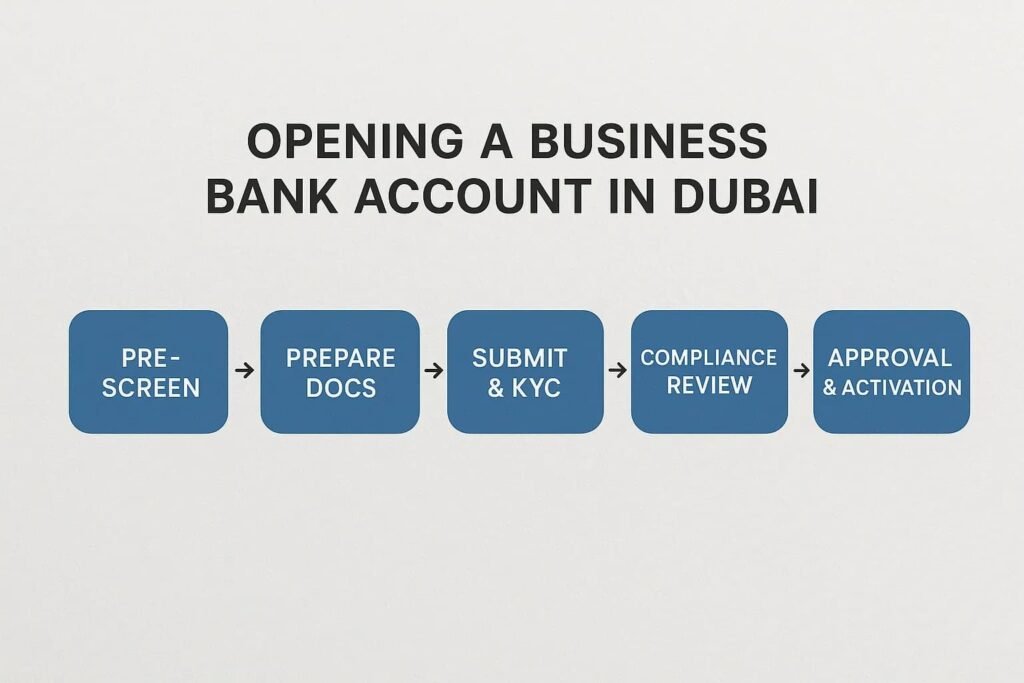
- Map your requirements, currencies, average balances, number of users, payment corridors, cash management tools.
- Shortlist banks, match risk appetite and sector familiarity, then request an informal pre-screen with a relationship manager.
- Prepare documents, attest foreign documents, translate to English or Arabic where needed, align UBO and license data.
- Submit the application, include a simple one page business profile and a flow of funds diagram to reduce queries.
- Complete KYC interview, in branch or through verified eKYC like UAE PASS, see uaepass.ae.
- Respond to compliance queries, provide sample contracts, invoices, and supplier or customer references.
- Receive approval, fund the account, set up online banking and user entitlements.
Timelines, balances, and fees, what to expect
Actual numbers depend on the bank and your risk profile. The ranges below are indicative based on recent cases handled by ADS Auditors.
| Item | Personal account | Business account |
| Typical timeline | 3 to 10 business days for residents | 2 to 6 weeks, longer if EDD is needed |
| Minimum balance | Zero balance or salary transfer variants available, premium tiers require higher balances | Often AED 25,000 to AED 100,000 average monthly balance, some banks allow lower with package fees |
| Monthly fees | From zero to AED 50 to AED 150, waived above balance thresholds | Package fees apply if minimums are not met, plus transaction pricing for international payments |
Tip, request the bank’s tariff guide up front so you can compare total cost of ownership across likely transaction volumes.
2025 trends shaping approvals
- Tighter UBO and substance checks, banks match your filings with MOE records and your trade license activities.
- Corporate tax awareness, banks do not enforce tax but increasingly ask for your status and bookkeeping readiness to assess legitimacy, see the Federal Tax Authority’s corporate tax hub.
- Remote KYC maturity, more banks accept video KYC for renewals and some openings, though first time signatories are often asked to visit a branch.
- Sector risk weighting, cash intensive and cross border trading models face more probing, tech and service models still need clear contracts and IP rationale.
Lessons learned, three real investor examples
- European SaaS founder, free zone company: initial application stalled because revenue evidence was limited to a pitch deck. Approval followed after providing two signed service agreements, a product demo link, and a six month cash flow showing modest inbound transfers. Lesson, show real contracts and go live proof.
- FMCG trader, mainland LLC: bank questioned a virtual office. A small warehouse lease and a logistics agreement with a 3PL resolved concerns. Lesson, demonstrate operational footprint that matches your license.
- Nonresident owner, holding company: several rejections due to complex shareholding. Simplifying the structure chart, appointing a UAE based manager as authorized signatory, and supplying legalized parent company accounts led to approval. Lesson, clarity of UBO and governance shortens compliance review.
Common reasons for delays or rejections
- Activity mismatch between trade license and invoices or website content
- No proof of address or insufficient tenancy documentation
- Unexplained large first deposits or intercompany loans without agreements
- Overly complex ownership charts without legalized supporting documents
- Attempting to open business bank account before the company is fully licensed or without a signatory present in the UAE
A practical readiness checklist
Use this one page checklist before you apply. If you answer no to any item, fix it first, or expect questions.
My license activities match my website, invoices, and contracts.
I have 6 to 12 months of statements that support declared sources of funds.
My UBO chart is accurate and reconciles to MOE filings.
I can evidence a real operating footprint, lease, warehousing, or service delivery agreements.
I know my expected volumes, currencies, and counterparties by country.
How ADS Auditors helps you move faster
ADS Auditors supports entrepreneurs and corporates with end to end Bank Account Opening in Dubai. We pre-screen your profile, assemble bank specific document packs, align your UBO and substance story with your license, and coach signatories for KYC interviews. Our accounting and corporate tax teams prepare the financial narratives banks expect to see, and our compliance calendar tool helps you keep periodic KYC updates on track after opening. Start a conversation at adsauditors.com.
Sources and regulatory references
- Central Bank of the UAE, AML and CFT, centralbank.ae/en/aml-cft
- Ministry of Economy, Beneficial Ownership updates, moec.gov.ae
- Federal Tax Authority, Corporate Tax, tax.gov.ae/en/corporate-tax
- UAE PASS, Digital identity for eKYC, uaepass.ae
Frequently Asked Questions
Can I open a UAE bank account without residency?
Some banks allow nonresident personal or corporate accounts, but expect higher minimum balances, stricter KYC, and longer timelines. A local signatory with Emirates ID often accelerates approval for companies.
What is the fastest way to open business bank account in Dubai?
Pre-screen with two or three banks before you file, then submit a complete pack including a one page business profile, UBO chart, contracts or invoices, and a simple flow of funds diagram. This reduces compliance queries.
Do free zone companies face more scrutiny than mainland?
Not necessarily. Banks focus on substance and clarity. A free zone entity with contracts and a credible operating setup can be approved faster than a mainland LLC with weak documentation.
Will banks ask about corporate tax?
Banks are not tax authorities, but many request your status and basic bookkeeping readiness to validate that your business is legitimate and well governed. See the Federal Tax Authority for details.
How much initial deposit do banks require?
Policies vary. Many business accounts require maintaining an average monthly balance rather than a fixed opening deposit. Ask for the current tariff and minimum balance policy for your chosen package.
Ready to move from paperwork to a working account, without surprises? Speak to ADS Auditors for a tailored bank selection and document strategy that reflects your real business and accelerates approvals. Start at adsauditors.com.