
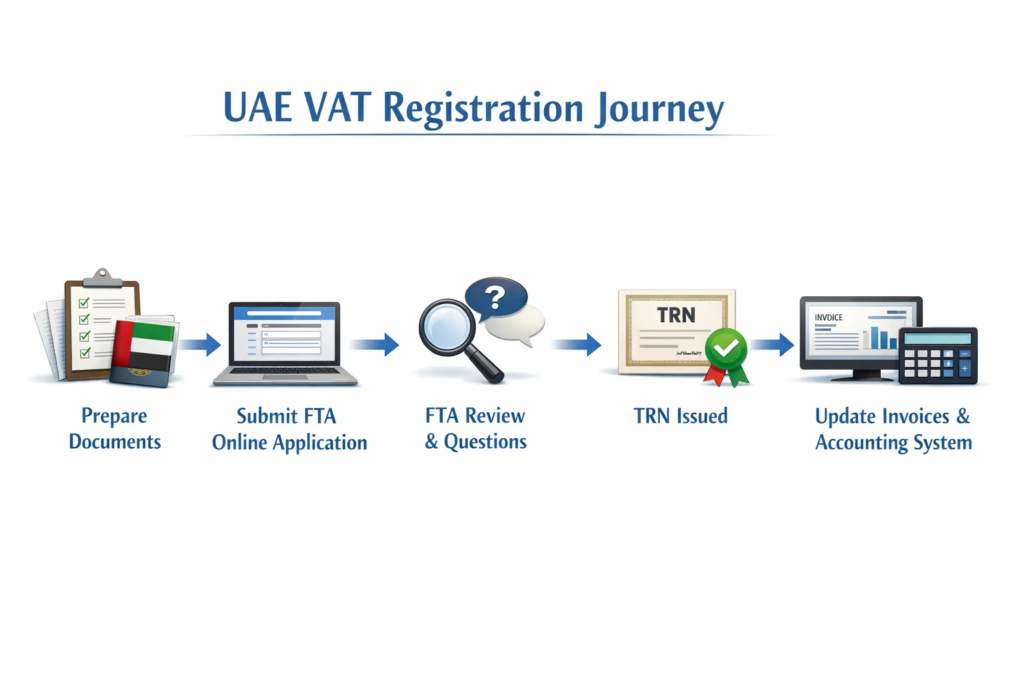
VAT registration in the UAE is often treated like a simple compliance task. In practice, it is a business milestone that affects pricing, cash flow, vendor onboarding, and even how investors and banks view your financial controls. If you are searching for How to Do VAT Registration, the goal is not only to get a Tax Registration Number (TRN), it is to register at the right time, with clean data, so you avoid delays and protect future VAT recovery.
This guide explains UAE VAT registration service requirements, the step-by-step process, and what timeline to expect. It also adds strategic advice that many businesses learn only after the first Federal Tax Authority (FTA) review.
VAT registration requirements in the UAE (who must register)
The UAE applies a 5% VAT on most goods and services. A business generally needs to register when its taxable activity crosses specific turnover thresholds.
As per UAE VAT rules, the common thresholds are:
- Mandatory registration when taxable supplies and imports exceed AED 375,000 in the last 12 months (or are expected to exceed that in the next 30 days).
- Voluntary registration may be possible when taxable supplies and imports exceed AED 187,500 (often used by early-stage firms to recover input VAT).
For official guidance, always cross-check the latest updates on the UAE Federal Tax Authority website.
Quick comparison table: mandatory vs voluntary VAT registration
| Item | Mandatory registration | Voluntary registration |
| When it applies | You cross the legal threshold | You are below mandatory threshold but meet the voluntary level |
| Main benefit | Compliance and avoiding penalties | Ability to recover input VAT (if eligible) |
| Main risk | Late registration can trigger penalties | Extra admin work if your business is still very small |
| Best for | Established SMEs, fast-growing businesses | Startups investing heavily in expenses, equipment, marketing |
What documents and information you should prepare (before you apply)
Most VAT registration delays happen because businesses start the application without organizing the basics. Think of this step like preparing for a light due diligence review.
Typical items you may need include:
- Trade license and company legal details
- Emirates ID and passport copies for owners or authorized signatories (as applicable)
- Proof of business address
- Business activity description (what you sell, who you sell to, where you sell)
- Historical sales data and invoices (to support the threshold calculation)
- Bank account details and supporting financial information (often requested)
Lesson learned from real cases: many companies can prove turnover, but struggle to prove it cleanly. If your invoices, bank entries, and accounting records do not match, the application can take longer.
If you are already working with tax consultants in UAE or audit firms in Dubai, ask them to review your turnover calculation before you submit. A one-hour check can save weeks.
How to do VAT registration (step-by-step process)
VAT registration is done through the FTA’s online portal. The exact screens can change, but the overall workflow stays consistent.
- Create or access your FTA account (your business profile must be set up correctly).
- Start the VAT registration application and fill in company identity, activities, and contact details.
- Declare turnover and expected turnover with clear numbers and support.
- Add owner and authorized person details (ensure names and IDs match legal documents).
- Upload supporting documents (use clear scans and consistent filenames).
- Review carefully and submit (many delays come from small data entry errors).
- Wait for FTA review and respond quickly if they request clarification.
- Receive your TRN and VAT registration certificate once approved.
After approval, update your invoicing setup so your tax invoices contain the required VAT details and TRN.
VAT registration timeline: what to expect and what can slow it down
Many businesses plan VAT registration as if approval is instant. A more realistic approach is to plan for review time, internal approvals, and document clean-up.
A common market expectation is:
- Well-prepared applications: often processed in about 2 to 4 weeks
- Applications with missing or inconsistent documents: can take longer due to follow-ups
Practical timeline chart (typical scenario)
| Phase | What happens | Typical time window |
| Preparation | Collect docs, confirm turnover, fix invoice gaps | 2 to 7 days |
| Submission | Complete online form and upload files | 1 day |
| FTA review | Review, questions, clarifications | 2 to 4 weeks (often) |
| Go-live | Start issuing compliant tax invoices | Immediately after TRN |
Strategic tip: If you expect to raise funding, sign large contracts, or bid on tenders, start VAT registration earlier than you think. Counterparties often ask for your TRN during onboarding.
Strategic decisions that affect VAT outcomes (not just registration)
1) Registering “on time” vs “late”
Late registration is not only about penalties. It can also create messy back-dated VAT corrections. For example, you might have issued invoices without VAT when you should have charged VAT. Fixing that later can damage customer trust and reduce margins.
2) Planning for VAT refunds from day one
VAT registration is also the starting point for potential input VAT recovery. In some models, VAT recovery can be material.
Example (simple cash flow math):
| Expense type | Net cost | VAT at 5% | Cash impact if you can recover VAT |
| Equipment purchase | AED 200,000 | AED 10,000 | AED 10,000 may be recoverable (subject to rules) |
| Marketing services | AED 80,000 | AED 4,000 | Reduces real cost if recovered |
If your business frequently ends up in a refund position (for example, exporters or businesses with heavy input costs), you should build processes early. This is where vat refund services in UAE can be valuable, not only for filing, but for keeping a strong audit trail.
If your operations are Dubai-centered, teams often search for vat refund dubai support when refund claims are delayed because of weak documentation.
3) Aligning VAT with investor expectations
Investors do not just look at growth. They look at whether your financial reporting is “investable.” VAT compliance is a quick signal of maturity.
Investor example (anonymized): A UAE-based e-commerce startup prepared for a seed round. During due diligence, the investor asked for:
- TRN and VAT registration certificate
- VAT returns (or proof of filing status)
- A VAT reconciliation showing sales per platform matched bank receipts
The founder had sales growth, but weak VAT records created delays in closing because the investor wanted comfort that tax exposure was limited. The fix was simple, but it took time because the data was not ready.
To understand the full process in detail, read our complete guide on how to register for VAT in UAE for a new company.
Common VAT registration mistakes and how to avoid them
Most issues are preventable if you treat VAT registration like a controlled project.
- Turnover calculated incorrectly (mixing taxable and exempt supplies without clarity)
- Mismatch between trade license activity and VAT narrative (the “what we do” description must be consistent)
- Unclear supporting documents (blurry scans, missing pages, inconsistent names)
- Bank and invoice records not aligned (creates questions during review)
Many businesses choose VAT Registration Services because the cost of a delay is higher than the service fee. Delays can block vendor registration, cause contract issues, and slow down recoveries.
To understand the full verification process, read our detailed guide on How to Check a VAT Registration Number in UAE: Step-by-Step Guide.
When to get help from ADS Auditors
If you want VAT registration done with fewer back-and-forths, support from experienced advisors can reduce risk. ADS Auditors supports businesses in Dubai and internationally across VAT, corporate tax, accounting, and compliance.
If you prefer a guided approach, ADS Auditors can help you:
- Confirm whether you should register (mandatory vs voluntary)
- Prepare and review documents before submission
- Reduce avoidable errors that can slow FTA review
- Set you up for ongoing compliance and (when applicable) vat refund services with strong documentation
Frequently Asked Questions
How to do VAT registration in the UAE for a small business?
You first confirm if you meet the mandatory or voluntary threshold, then submit the VAT registration application through the Federal Tax Authority portal with supporting documents (trade license, IDs, turnover proof, and business details). Small businesses should focus on clean invoices and a clear turnover calculation to avoid delays.
How long does VAT registration take in the UAE?
Many well-prepared applications are often completed in about 2 to 4 weeks, but timelines can vary based on document quality and whether the FTA requests clarifications.
Can I register for VAT voluntarily in the UAE?
Yes, voluntary registration may be available when your taxable turnover exceeds AED 187,500 (subject to rules). It is commonly used by startups and growing companies that want to recover input VAT.
What happens after I receive my TRN?
You must start issuing compliant tax invoices, charge VAT where required, keep VAT records, and file VAT returns on time. You should also ensure your accounting system is VAT-ready.
Do I need VAT refund services after VAT registration?
Not always. If your input VAT is consistently higher than output VAT (common for exporters or high-spend phases), you may benefit from vat refund services in UAE to support claims with proper documentation and reduce rejection risk.
Need help with VAT registration and ongoing compliance?
If you want to register correctly the first time and set up VAT processes that stand up to reviews, consider working with ADS Auditors. Their team supports VAT registration, filings, and documentation discipline that also helps with audits, investor due diligence, and refund readiness. Visit adsauditors.com to speak with their team about VAT registration support.