
AML rules are no longer only a bank problem. In the UAE, regulators and banks increasingly expect many businesses to register for AML (Anti Money Laundering), set up controls, and prove they are monitoring risk. If you operate in real estate, corporate services, precious metals, or other higher risk sectors, AML registration can directly affect your ability to open and keep bank accounts, onboard large clients, and close investor due diligence.
This guide explains What Is AML Registration, what it typically includes in the UAE (including goAML access and supervisory registration), who needs it, and how to approach it strategically.
What is AML registration?
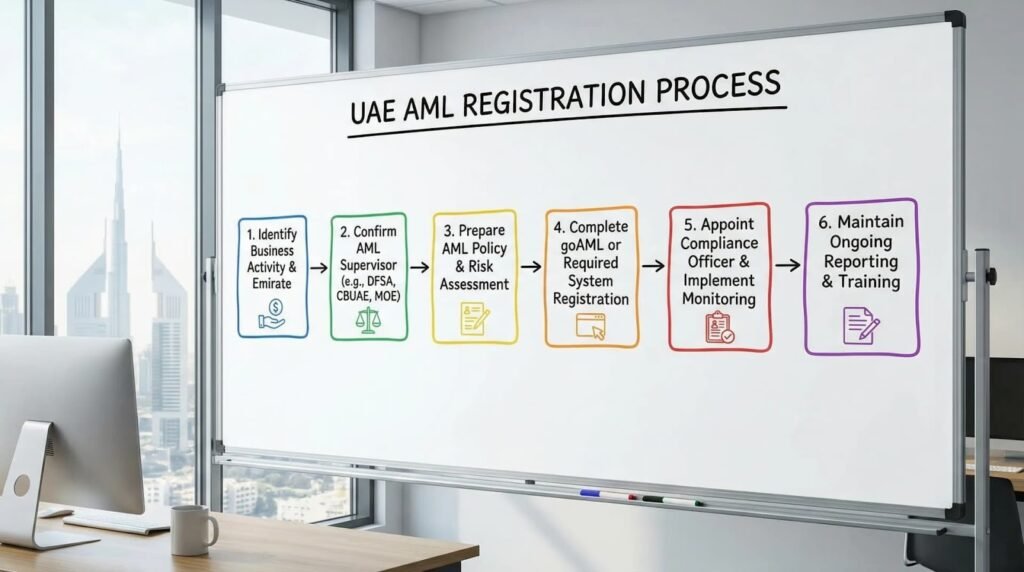
AML registration is the process of enrolling your business with the relevant AML supervisory authority and systems so you can meet UAE Anti Money Laundering and Counter Terrorist Financing (AML/CFT) obligations.
In practical terms, AML registration usually means:
- Identifying your correct AML regulator (this depends on your activity and whether you are mainland or in a financial free zone).
- Registering your business and compliance officer details where required.
- Getting access to the reporting channel used to file suspicious activity reports (in the UAE, this is commonly associated with the goAML platform for many reporting entities).
- Being able to evidence that you have an AML framework, not just a certificate.
The business reason is simple: registration moves you from “unknown risk” to “known and managed risk,” which is exactly what banks and professional investors want.
Read our detailed article on the key factors to consider when hiring an AML consultant in the UAE.
Why AML registration is getting more important in 2026
Global enforcement pressure keeps rising, and the UAE is deeply connected to international finance. A widely cited estimate from the United Nations Office on Drugs and Crime (UNODC) suggests that money laundering is around 2% to 5% of global GDP. That scale explains why regulators and banks keep tightening onboarding checks and monitoring expectations.
In the UAE, this shows up as:
- More detailed bank KYC questions about source of funds, customer types, and transaction patterns.
- Faster escalation when documents are missing, inconsistent, or outdated.
- Stronger expectations that finance teams link AML controls to accounting records (invoice trail, contracts, proof of delivery).
This is also where strong corporate accounting services help. Clean books are not only for tax, they are also the evidence base for AML.
Who typically needs AML registration in the UAE?
If your business operates in the Northern Emirates, especially Ajman, working with a local AML Service Provider in Ajman can simplify the process. These providers understand jurisdiction-specific requirements, documentation expectations, and coordination with the relevant supervisory authorities. For SMEs and service-based businesses, this localized support can reduce delays in registration and improve readiness for bank compliance checks.
AML registration obligations vary by sector and jurisdiction. The two broad groups are:
- Financial institutions and certain financial activities (often regulated by the Central Bank or financial free zone regulators).
- DNFBPs (Designated Non Financial Businesses and Professions) such as certain real estate activities, dealers in precious metals and stones, and trust or company service providers.
If you operate across emirates, you may see location specific search intent like AML services in Dubai or AML Registration in Abu Dhabi. The underlying principle is the same, but the supervising authority and onboarding process can differ.
Quick decision table (high level)
| Business type (examples) | Common AML expectation | Typical first check you should do |
| Real estate brokerage or related services | Often treated as higher risk sector, may be DNFBP | Confirm if your activity triggers DNFBP obligations and the correct supervisor |
| Trust or company service activities (company formation, nominee services, corporate admin) | Common DNFBP trigger | Map services to AML obligations and register if required |
| Dealers in precious metals and stones | Often DNFBP | Document customer onboarding, cash handling, and source of funds controls |
| Financial activities and some virtual asset activities | Regulated financial entity expectations | Identify the regulator for your license and reporting obligations |
Note: Always confirm scope with the competent authority for your license category and emirate.
What changes after you register and what investors will ask for?
Registration is not the finish line. It is the start of an operating model. After AML registration, most businesses should be ready to show:
- A documented AML risk assessment (who your customers are, where funds come from, delivery channels, geographies).
- Customer due diligence (CDD) and enhanced due diligence (EDD) rules.
- Sanctions and PEP screening process.
- Ongoing monitoring and internal escalation.
- Staff training and evidence logs.
- Suspicious transaction reporting process where applicable.
From an investor’s viewpoint, AML is not “paperwork.” It is a risk that can break a deal.
Real investor example (what happens in due diligence)
A common scenario we see in regional transactions is this: a growth stage services company negotiates funding, but the investor’s legal and compliance workstream asks for AML evidence because the company onboards many overseas clients and receives cross border payments. The founder can explain the business model, but cannot produce a documented AML framework, training logs, or consistent KYC files.
Result: the investor does not always walk away, but they often do one of the following:
- Reduce valuation due to “compliance discount.”
- Add stronger warranties and indemnities.
- Delay closing until remediation is complete.
That delay can cost more than the AML program itself, especially if payroll and growth spend depend on the investment.
Verify your KYC details instantly online.
A practical playbook: how to approach AML registration the smart way?
Below is a business friendly approach that reduces rework and helps you pass bank and investor checks.
Step 1: Confirm whether you are in scope
Start with your license activity, your actual services (not only what is written on the license), and where you operate (mainland, free zone, financial free zone). If your company provides corporate services, handles higher risk customers, or works with large cash equivalent flows, treat AML scope as a priority question.
Step 2: Map your regulator and reporting channel
In the UAE, different sectors report to different supervisory authorities. Many reporting entities also need access to goAML for suspicious activity reporting. Getting this wrong can create delays, especially when a bank asks for evidence that you are registered and able to report.
Step 3: Build the evidence pack before you submit
Do not treat this as form filling. Build a small “inspection ready” pack:
| Evidence item | Why it matters in registration and reviews | What “good” looks like |
| AML policy and procedures | Shows governance and controls | Tailored to your customer types and transaction flow |
| Business risk assessment | Proves risk based thinking | Clear risk rating logic, updated at least annually |
| KYC checklist and templates | Ensures consistent onboarding | Includes UBO checks, source of funds triggers |
| Training plan and logs | Regulator and bank expectation | Role based training with attendance evidence |
| Record keeping rules | Supports audits and investigations | Clear retention period, secure storage |
Step 4: Appoint the right AML roles
Registration often requires naming a responsible person. Choose someone who can coordinate operations, sales onboarding, and finance. AML fails most often in the “handoff” between sales and finance.
Step 5: Connect AML controls to accounting
This is where experienced advisors and best accounting firms in dubai stand out: they can help you align KYC, invoicing, and bank narratives.
For example, if your invoice describes “consulting,” but your contract describes “marketing lead generation,” and your bank narrative says “software services,” you have created an avoidable compliance problem.
Step 6: Prepare for ongoing monitoring, not only registration
Banks care about what happens after onboarding. Create a cadence for:
- Periodic customer refresh (especially high risk customers)
- Exception reporting
- Management oversight
Common mistakes businesses make and how to avoid them?
Many firms fail AML registration or later bank reviews because they copy generic templates.
Here are the most common patterns:
- Copy paste AML policy that does not match actual customer onboarding.
- No proof of training, even if training happened informally.
- Weak source of funds logic, especially for overseas payments.
- No link to finance data, meaning transactions cannot be explained quickly.
A strategic fix is to treat AML as part of your “investor grade finance stack,” together with VAT, corporate tax, and monthly closing.
Where ADS Auditors fits in?
ADS Auditors supports businesses with compliance and advisory work across tax, accounting, and AML. If you are coordinating multiple workstreams (banking, VAT, corporate tax, and AML), working with one team can reduce gaps between what your business does and what your documents say.
If you want to explore support options, you can review ADS Auditors resources on AML compliance in UAE and related location specific guidance such as AML Registration in Abu Dhabi.
Frequently Asked Questions
What Is AML Registration and why does my business need it?
AML registration is the process of registering with the relevant AML authority and systems (often including goAML access) so your business can meet UAE AML obligations. It helps you reduce regulatory and banking risk.
Is AML registration only for banks and financial institutions?
No. Many DNFBPs can be in scope too, such as certain real estate activities, dealers in precious metals and stones, and trust or company service providers.
What documents are usually needed for AML registration?
Many businesses should prepare an AML policy, risk assessment, KYC forms and checklists, compliance officer details, training plan, and record keeping process.
DoesAML Registration in Abu Dhabi differ from Dubai?
The core AML expectations are similar, but the supervising authority and practical process can differ depending on your license, activity, and jurisdiction.
Can tax consultants in Dubai help with AML registration?
Some advisory firms cover both tax and compliance. AML is not a tax filing, but aligning AML evidence with your accounting and tax records is often critical for bank and investor reviews.
Get help with AML registration and ongoing compliance
If you are unsure whether you need AML registration, or you want an evidence ready AML framework that stands up to bank and investor scrutiny, ADS Auditors can help you assess scope, prepare the documentation pack, and implement practical controls.
Explore AML services in Dubai or contact ADS Auditors via adsauditors.com to discuss your next steps