
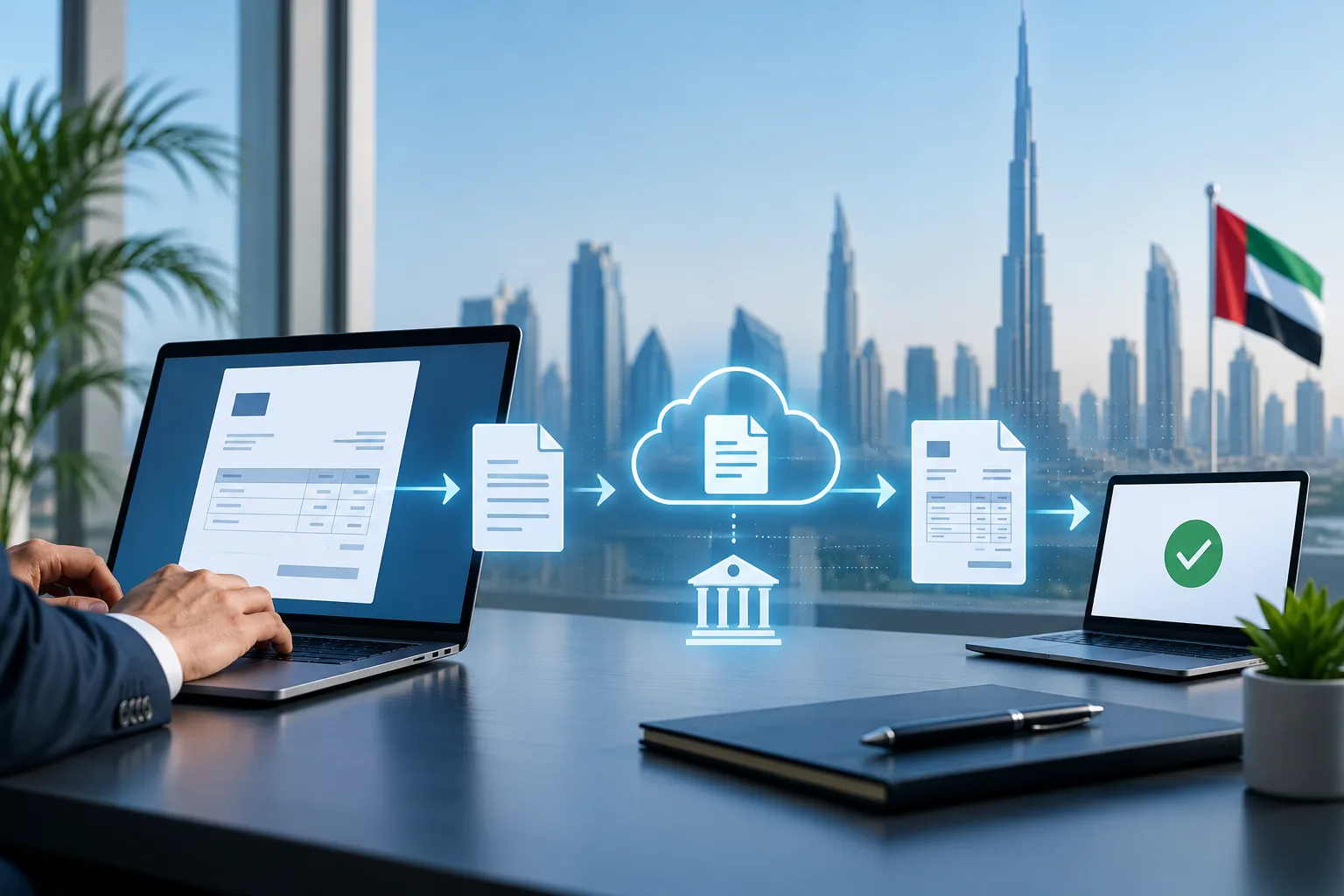
How UAE E-Invoicing works is simple: a business creates an invoice in a structured digital format and sends it through an approved electronic network instead of exchanging a paper or PDF-only invoice. The same digital invoice is delivered to the buyer and, where required, made available for tax reporting so the transaction can be checked and stored with less manual effort.
In the UAE, e-invoicing is becoming part of a wider move toward digital tax administration, stronger VAT controls and cleaner business records. Understanding how UAE E-Invoicing works helps finance teams prepare systems, train staff and reduce last-minute compliance risk. This guide takes a practical business view of the UAE e-invoicing process, covering eligibility, data preparation, invoice exchange, validation and record keeping.
If your company already manages VAT, corporate tax or cross-border transactions, the steps below will help you plan before the mandate applies to your business.
What UAE E-Invoicing Means for UAE Businesses
How UAE E-Invoicing works in practice starts with the invoice format. An e-invoice is not just a scanned bill or a PDF sent by email. It is a structured digital document that accounting systems can read, validate and share through an approved channel.
At its core, how UAE E-Invoicing works is a controlled exchange of invoice data between the supplier, the buyer and the e-invoicing network. The goal is to reduce manual entry, duplicate errors and audit pressure while giving businesses cleaner records for VAT and corporate tax compliance.
This matters because invoice data sits at the center of tax compliance UAE. A small error in customer details, VAT treatment or invoice numbering can affect VAT return preparation, revenue reporting and audit readiness. Firms such as ADS Auditors can help businesses connect e-invoicing planning with wider accounting services, VAT services and corporate tax services.
Step 1: Confirm Eligibility and Scope
Before mapping how UAE E-Invoicing works for your company, confirm eligibility. Eligibility may depend on transaction type, legal registration, VAT status, sector, mandate phase and whether your invoices are B2B, B2G, B2C or cross-border.
Do not assume that e-invoicing only applies to large companies. Many UAE businesses issue taxable invoices, credit notes and debit notes that may eventually fall within the UAE e-invoicing process. Free zone companies, mainland entities and international businesses with UAE tax obligations should review their position early.
If your VAT or corporate tax status is still being regularized, it is better to handle that first. Businesses can review ADS Auditors support for VAT Registration and Corporate Tax Registration before moving into system implementation.
Step 2: Clean Your Invoice and Customer Data
The UAE e-invoicing process depends on accurate master data. Before connecting software or appointing a service provider, review customer names, addresses, tax registration numbers, product codes, VAT categories and invoice numbering sequences.
This is where many businesses discover long-standing problems. For example, a customer name in the sales system may not match the name in the VAT file, or invoice line descriptions may be too vague for automated validation. Cleaning this data early makes implementation faster and lowers rejection risk.
Step 3: Choose the Right System and Service Provider
A business will need accounting software or an ERP setup capable of creating structured invoice data. Depending on the UAE framework and the latest official requirements, invoices may also need to pass through an approved or accredited service provider.
Businesses that want a guided implementation can use ADS Auditors' E-Invoicing Consultation to assess software readiness, data quality and internal controls. This is especially useful for companies with multiple branches, high invoice volumes or industry-specific billing rules.
Step-by-Step: How UAE E-Invoicing works from invoice creation to storage
The practical flow is easier to understand when broken into stages. How UAE E-Invoicing works from this point depends on your systems, but most businesses will follow a process similar to this:
This is why how UAE E-Invoicing works is closely linked to your accounting workflow. The invoice should not be treated as a separate tax document that is fixed later. It should be accurate at the point of issue.
Step 4: Validate Before Sending
Validation is one of the most important parts of the UAE e-invoicing process. A compliant invoice should include the right supplier and buyer details, tax registration numbers when applicable, invoice date, line-item data, VAT treatment and totals.
If a field is missing or inconsistent, the invoice may need correction before it can be exchanged. This can delay customer billing and payment collection. A strong approval workflow helps your finance team catch errors before the invoice reaches the buyer.
Step 5: Reconcile With VAT, Corporate Tax and Audit Records
Another part of how UAE E-Invoicing works is record retention. Your business must be able to match e-invoices with accounting entries, VAT returns, credit notes, payment records and supporting contracts.
This creates a useful compliance advantage. When invoice data is structured and consistent, tax teams can prepare VAT filings more efficiently and identify discrepancies earlier. It also supports audit services UAE because the audit trail is easier to follow.
For business advisory Dubai needs, e-invoicing should be reviewed alongside pricing policies, billing controls, software access rights and month-end closing procedures. The technology matters, but the internal process matters just as much.
Common Mistakes to Avoid
When teams misunderstand how UAE E-Invoicing works, they often focus only on software and ignore process control. That can create compliance gaps even if the accounting platform is modern.
Avoid these common errors:
Treating a PDF as a compliant e-invoice when structured data is required.
Waiting until the last phase of implementation to check eligibility.
Keeping weak customer or supplier master data.
Ignoring VAT treatment and tax code mapping during setup.
Failing to train sales, finance and accounts payable teams.
Not testing invoice cancellation, credit notes and debit notes.
As implementation expands, how UAE E-Invoicing works may vary by business model and transaction type. A trading company, a consultancy, a real estate business and a multi-branch retailer may each need a different setup.
Conclusion
How UAE E-Invoicing works can be summarized in five practical actions: confirm eligibility, clean data, choose a suitable system, validate invoices before sending and store records properly. Businesses that prepare early will have fewer billing delays, stronger VAT records and better audit readiness.
ADS Auditors helps UAE businesses connect e-invoicing with tax consultancy, VAT services, corporate tax services, accounting services and business advisory Dubai support. To assess your eligibility, software readiness and compliance risks, Contact ADS Auditors and schedule a consultation today.
Frequently Asked Questions
Leave a Comment
Have a question or a thought on this article? Share it below and our team will be in touch.